For thousands of years, humans naturally consumed small traces of copper from soil, water flowing over rocks, and—more recently—from copper plumbing inside homes.
Today, that source is gone.
And the result is a silent deficiency that affects hair pigmentation, skin vitality, cellular energy, antioxidant defenses, and more.
In this blog, you’ll learn:
- how we transitioned from copper pipes to PVC plumbing
- why this changed the mineral content of water
- how this shift contributes to modern copper deficits
- and why the most effective way to restore copper today is through bioavailable nanoparticles in ultra-pure water
1. When Water Naturally Contained Copper
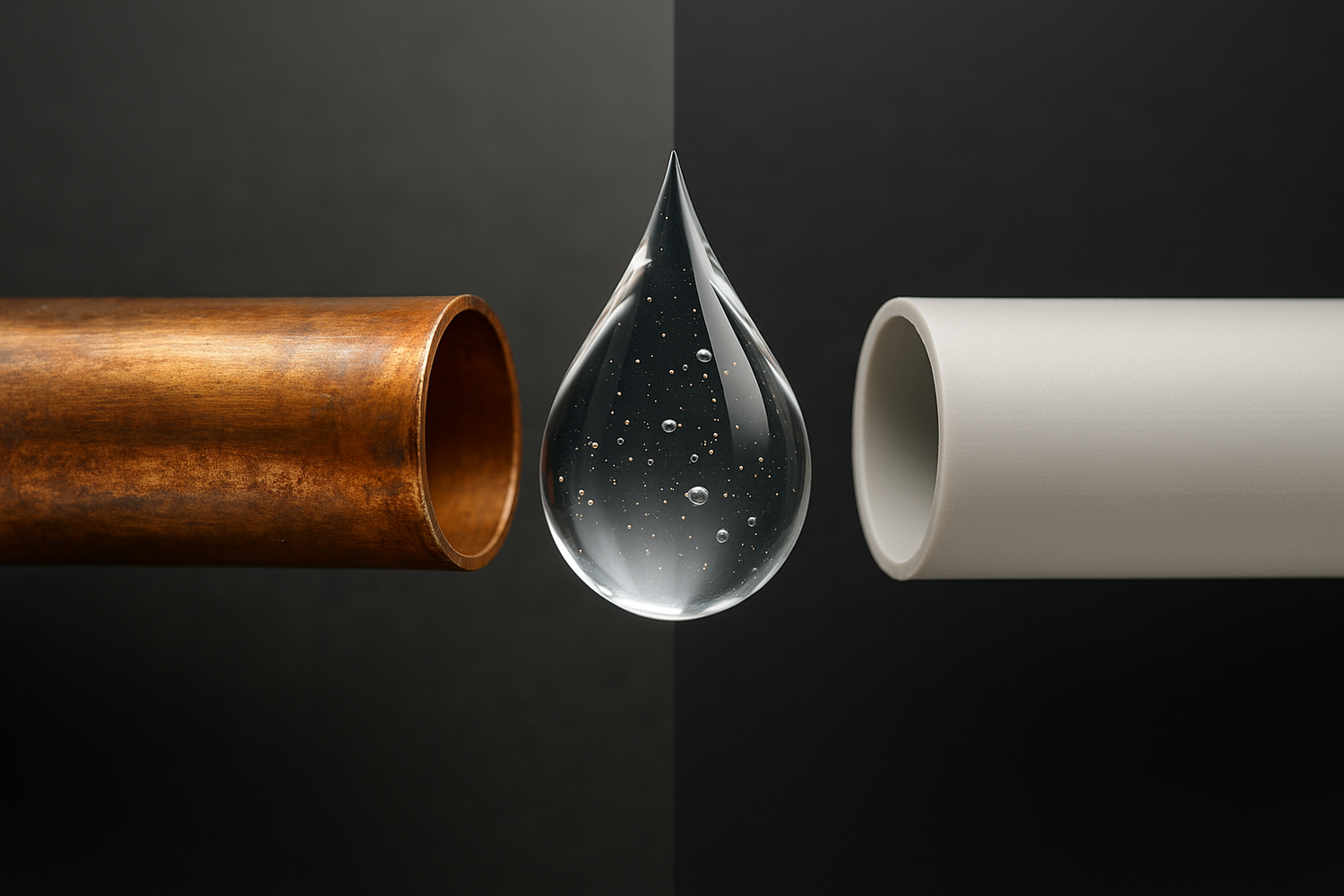
Before the 1970s, most homes used copper pipes. Beyond their antimicrobial advantages, these pipes did something else:
➜ They released tiny, harmless traces of copper into drinking water.
Small amounts, yes—but enough to support:
- melanin production (hair and skin pigmentation)
- cellular energy metabolism
- collagen formation and connective tissue strength
- antioxidant defense systems (SOD1 activity)
The Journal of Trace Elements in Medicine and Biology has long described copper as “essential for pigmentation, energy, and structural tissue integrity.”
Research from the US National Research Council also notes that unintentional intake from copper plumbing once contributed to meeting part of the daily recommended copper intake.
In other words: we didn't need to supplement copper—our environment supplied it.
2. The Silent Switch: From Copper Pipes to PVC
Between the 1970s and 1990s, construction industries replaced copper with PVC (polyvinyl chloride) and PEX in plumbing.
Why?
- cheaper
- easier to install
- flexible
- corrosion-resistant
- meets modern water standards
But the invisible cost was this:
- PVC does not release minerals.
- It adds nothing beneficial to water.
- It eliminated the natural copper traces we once consumed daily.
And so began the modern copper deficit.
According to Environmental Health Perspectives, the switch from metallic plumbing to PVC significantly reduced natural trace mineral exposure.
The NIH also notes that modern diets + environmental changes are linked to growing subclinical deficiencies in essential minerals—including copper.
3. What Happens When Copper Levels Drop?
Copper is required for over 50 enzymatic processes in the human body, including:
- Tyrosinase → essential for melanin (hair pigmentation)
- Cytochrome-C oxidase → mitochondrial energy production
- SOD1 → antioxidant defense
- Lysyl oxidase → collagen and connective tissue formation
This explains why studies associate copper deficiency with:
✔ Premature graying
Reduced copper → reduced tyrosinase → reduced melanin. *Biological Trace Element Research* (2012) explores this relationship.
✔ Dull or fragile skin
Copper supports collagen cross-linking and structural integrity. Documented in the Journal of Dermatological Science.
✔ Low energy
Copper is required for mitochondrial ATP pathways.
✔ Weak antioxidant defenses
Reduced SOD1 activity decreases the body’s ability to neutralize free radicals.
These are not always severe clinical deficiencies—they are often subtle but cumulative.
4. The Problem With Traditional Copper Supplements
People commonly try to correct copper deficiencies with:
- copper pills
- multivitamins
- mineral salts
However, these come with issues:
❌ Low absorption
Copper salts must be digested, ionized, and transported—most is lost in the process.
❌ Digestive discomfort
Frequent with copper sulfate or gluconate.
❌ Oxidation
Copper salts oxidize quickly when exposed to contaminants in water or the digestive tract.
As highlighted in Minerals in Human Health (Springer, 2013), copper bioavailability depends heavily on the purity of the water medium.
5. The Modern Solution: Copper Nanoparticles in Ultra-Pure Atmospheric Water
This is where the new science becomes clear:
Copper nanoparticles + NUBE atmospheric ultra-pure water = maximum stability and maximum absorption
✔ Nanoparticles → no digestion required
They absorb through mucous membranes and cells directly.
✔ Ultra-pure water → zero interference
NUBE atmospheric water contains no:
- chlorine
- salts
- heavy metals
- microplastics
- pipe residues
This purity ensures:
- uniform particle size
- stable electrical charge
- clean, long-lasting suspension
- no clumping or oxidation
- high bioavailability
The Journal of Nanobiotechnology confirms that water purity determines whether nanoparticles remain active or agglomerate.
The International Journal of Nanomedicine notes that stable metallic nanoparticles improve cellular uptake and efficiency.
6. Why Your Body Needs Bioavailable Copper Today
Because our environment no longer provides it.
- mineral-depleted water
- processed modern diets
- nutrient-depleted soils
- oxidative stress
- increasing premature graying
- reduced collagen production
- fatigue and low energy
This is not a wellness trend—it's a 21st-century environmental deficiency.
We moved from a world where water naturally delivered copper… to a world where water delivers almost none.
Because copper is essential for pigmentation, energy, antioxidant function, and cellular structure, even mild deficiencies make a difference.
The modern solution isn’t more pills—it’s bioavailable copper nanoparticles suspended in the purest water available: NUBE atmospheric water.
Pure water + copper nanoparticles = a smarter way to support your body's natural copper needs.
References
- Milne DB. “Copper intake and its bioavailability.” Journal of Trace Elements in Medicine and Biology, 1998.
- Shaw, B. “PVC plumbing and exposure to environmental changes.” Environmental Health Perspectives, 2014.
- NIH Office of Dietary Supplements – Copper Fact Sheet.
- Biological Trace Element Research, 2012.
- Journal of Dermatological Science, 2009.
- Mitochondrion Journal, 2013.
- Free Radical Biology & Medicine, 2015.
- Singh et al., “Nanoparticle stability in aqueous media.” Journal of Nanobiotechnology, 2018.
- Zhang et al., “Metallic nanoparticles and improved cellular uptake.” Int. J. Nanomedicine, 2019.