noun
The capacity of a household to sustain reliable access to water — not just through a disruption, but independently of any single external system, long term.
Water resilience is not about surviving three days.
It's about not depending on systems that can fail.
Most conversations about water preparedness start and end in the same place: store enough water for 72 hours, keep a filter handy, have some bottles in the garage. That's emergency planning. It's useful — and it's not enough.
Water resilience is something different. It's the capacity of a household to maintain reliable access to water regardless of what happens outside — not for a weekend, but structurally. It's about reducing how much your water supply depends on infrastructure, supply chains, and systems you don't control.
The question is not how long you can survive a disruption. The question is how independent your home actually is from systems that can fail — and most homes, including experienced homesteads, are far more dependent than they realize.
What the numbers say
The gap between concern and actual preparedness is wide. Most people recognize the risk — but haven't built the system to address it.
Why one source is never enough
Most homes depend on a single water source. And every single source has exactly one point of failure.
Municipal supply
Can be contaminated, rationed, or interrupted during storms and infrastructure failures. The EPA mandates resilience plans for utilities — but those plans don't extend into your home.
Well water
Depends on a pump. The pump depends on power. No power — no water. And even when it runs: the USGS reports over 1 in 5 private wells contain contaminants like arsenic, uranium, or manganese above safe limits — most from natural geological sources. Most owners have never tested theirs.
Bottled water
Runs out within 48 hours under real consumption. Disappears from store shelves before a storm even makes landfall.
Delivery service
Doesn't arrive during emergencies — exactly when you need it most. Supply chains are among the first systems disrupted in a disaster.
The distinction that changes everything
There's a difference most people miss — and it's the difference between a household that manages a disruption and one that doesn't.
What you have when everything works.
Tap runs. Pump works. Delivery arrives on schedule. Easy to take for granted — until conditions change.
What you have when something stops working.
A backup source. A treatment method. A system designed to function even when your primary supply fails.
A home can have water and still be completely unprepared. A filter without a clean source solves nothing. A well without backup power is not a backup. Stored water without a rotation schedule goes bad before you need it.
The CDC recommends storing at least one gallon of water per person per day — and Ready.gov notes that a normally active person needs closer to three-quarters of a gallon for drinking alone. For a family of four, that's a minimum of 12 gallons for just 72 hours. Most homes don't have it. And storage alone isn't enough.
What a resilient water plan actually looks like
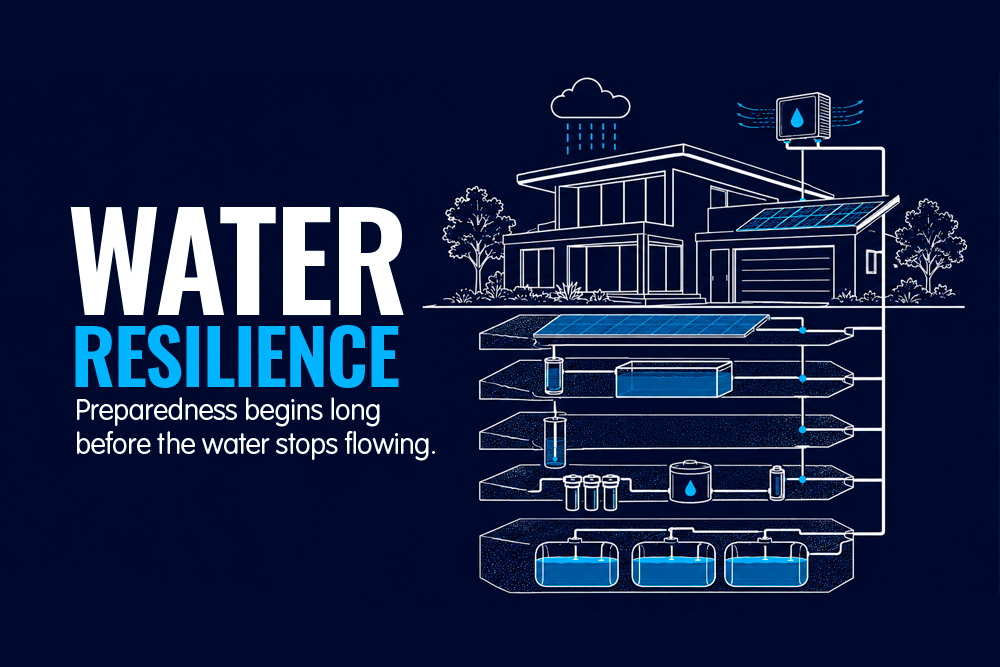
Water resilience is not one thing you buy or install. And it's not a 72-hour kit. It's a system built on four pillars — each one addressing a different dimension of your household's independence from external water sources.
The key difference: resilience is measured not in gallons stored, but in how well each pillar is covered — and how little your household needs from outside to keep all four functioning.
| Pillar | What it means — and its limit without the others |
|---|---|
| 01 — Source | Where your water comes from. The more your source depends on external infrastructure — grid power, supply chains, municipal systems — the lower your resilience ceiling. A truly resilient home has more than one source, and at least one that renews itself independently. |
| 02 — Storage | How you hold water between the source and the moment you need it. Storage buys time — but it has a hard limit. Poorly managed storage (wrong containers, no rotation, no sealing) can turn safe water into a health risk before you ever use it. |
| 03 — Quality | What you do to water between collection and consumption. A running source and a full tank don't guarantee safe water. Quality covers filtration, treatment, and verification — the practices that make the difference between water that looks fine and water that actually is. |
| 04 — Regeneration | The capacity of your system to replenish itself continuously, without external inputs. This is where the other three pillars converge: a source that renews itself, stored correctly, producing water that meets quality standards from the start. Without regeneration, every other pillar has an expiration date. |
The most common mistake
Treating water resilience like emergency preparedness.
Emergency preparedness asks: how long can we last? Water resilience asks: how independent are we? Those are fundamentally different questions — and they lead to fundamentally different systems.
A family with 12 gallons stored, a well, and a filter has done the emergency checklist. But if the well pump runs on grid power, if the filter depends on a clean source, and if 12 gallons is all they have — their resilience has a ceiling of about four days. After that, they're dependent on something outside their home working again.
The FEMA 2024 survey found that even among people who took preparedness actions, the most common step was assembling supplies — not building systems. Supplies are a floor. Systems without a regeneration layer are a ceiling. True resilience has neither.
The goal is not to stockpile against disaster. The goal is to build a household that functions — water and all — with as little dependence on external infrastructure as possible.
Water resilience is not a prepper concept. It's a design philosophy — the same logic behind any system built to function independently of the conditions around it.
The measure of water resilience isn't how many gallons you have stored.It's how long your household can function without needing anything from outside. Next: The four pillars of water resilience →
Sources
FEMA (2024). National Household Survey on Disaster Preparedness. fema.gov
FEMA (2023). National Household Survey on Disaster Preparedness. fema.gov
UNESCO / UN-Water (2024). UN World Water Development Report 2024: Water for Prosperity and Peace. unwater.org
United Nations (2024). SDG 6 Progress Report. un.org
U.S. EPA (2026). Resilience of Water and Wastewater Utilities. epa.gov
CDC (2024). WASH-related Emergencies and Outbreaks — Emergency Water Storage. cdc.gov
Ready.gov. Water — Emergency Supply Guidance. ready.gov




コメントを書く
すべてのコメントは公開前にモデレーションされます。
このサイトはhCaptchaによって保護されており、hCaptchaプライバシーポリシーおよび利用規約が適用されます。